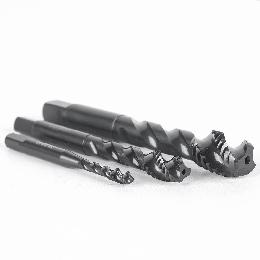
The black-oxide finish on these taps retains lubricants to improve the taps' wear resistance and chip flow. Black-oxide taps should only be used on ferrous metals. These taps meet DIN length standards and have a longer overall length than taps that meet ISO, ANSI, and JIS length standards. They also meet ANSI shank standards, which means they measure their shank diameter in inches and fit in standard tools used in the U.S.
+ Add to CartThe black-oxide finish on these taps retains lubricants to improve the taps' wear resistance and chip flow. Black-oxide taps should only be used on ferrous metals. These taps meet DIN length standards and have a longer overall length than taps that meet ISO, ANSI, and JIS length standards. They also meet ANSI shank standards, which means they measure their shank diameter in inches and fit in standard tools used in the U.S.
+ Add to CartThe TiN coating on these taps protects them from wear and allows them to be used at higher speeds than taps with a bright finish. Coolant-through taps have holes that allow coolant to flow to their tip to reduce heat and friction during threading tasks. These taps meet DIN length standards and have a longer overall length than taps that meet ISO, ANSI, and JIS length standards. They also meet ANSI shank standards, which means they measure their shank diameter in inches and fit in standard tools used in the U.S.
+ Add to CartUN coarse (UNC) taps have fewer threads per inch than UN fine (UNF) taps. Compared to UNF taps, UNC taps perform better in threading applications on brittle materials and are less likely to cross thread. Coarse threads can also withstand more physical abuse than fine threads. The black-oxide finish on these taps retains lubricants to improve the taps' wear resistance and chip flow. Black-oxide taps should only be used on ferrous metals.
+ Add to CartUN fine (UNF) taps have more threads per inch than UN coarse (UNC) taps. Compared to UNC taps, UNF taps perform better in threading applications on thin-walled workpieces and hard materials. Fine threads provide more tensile strength and shear strength than coarse threads. The black-oxide finish on these taps retains lubricants to improve the taps' wear resistance and chip flow. Black-oxide taps should only be used on ferrous metals.
+ Add to CartUN coarse (UNC) taps have fewer threads per inch than UN fine (UNF) taps. Compared to UNF taps, UNC taps perform better in threading applications on brittle materials and are less likely to cross thread. Coarse threads can also withstand more physical abuse than fine threads. The black-oxide finish on these taps retains lubricants to improve the taps' wear resistance and chip flow. Black-oxide taps should only be used on ferrous metals.
+ Add to Cart